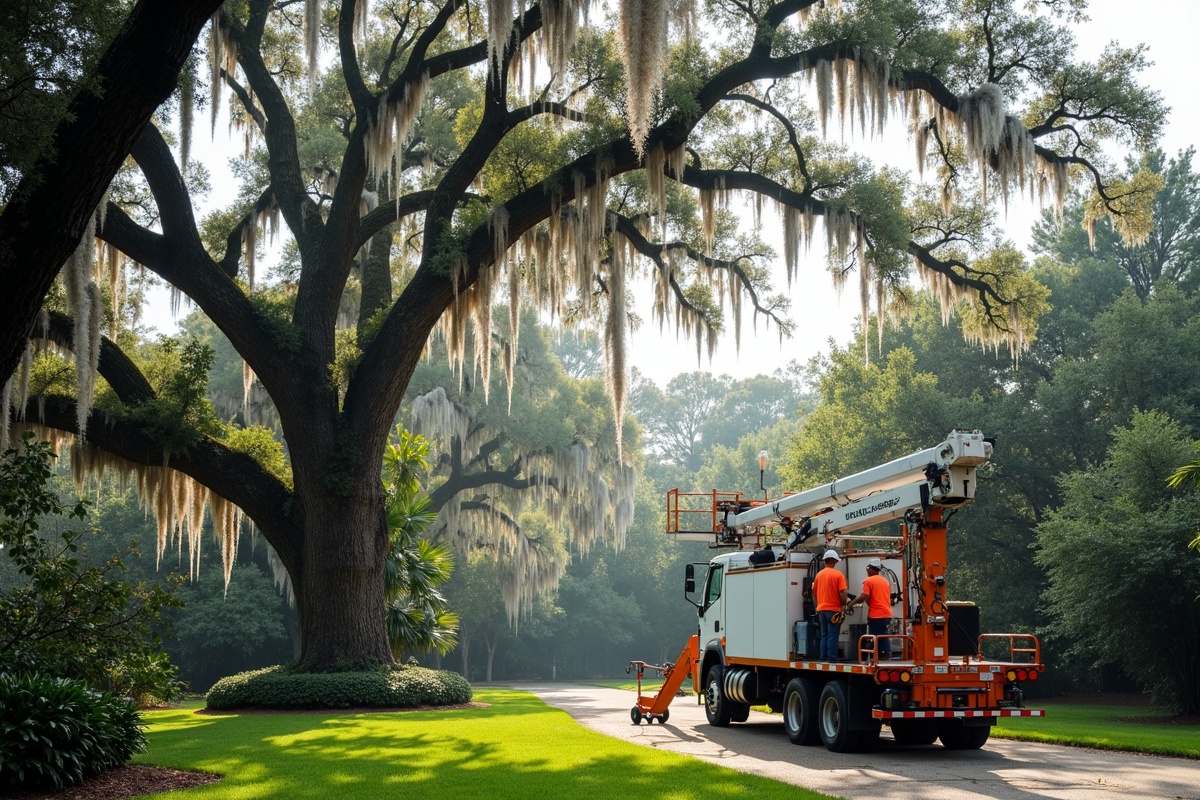
If you own a home in Savannah or anywhere along the Georgia coast, the trees on your property are both one of your greatest assets and, during a serious storm, one of your greatest risks. A well-kept live oak or a properly managed stand of pines can ride out a significant tropical system with little damage. A neglected one can put a limb through your roof, flatten your fence, block your driveway, or worse.
Savannah has lived this. Hurricane Matthew (2016) took down old oaks across the historic streets and left the city hauling off more than a million cubic yards of storm debris, much of it century-old trees. A year later, Hurricane Irma (2017) flooded Tybee Island and dropped trees and heavy limbs across town — onto historic homes in Ardsley Park, into Forsyth Park, across neighborhood streets. The lesson from both was the same: the trees that came through relatively intact were largely the ones maintained before the season. The trees that failed — snapping pines, splitting oaks, uprooted giants crushing fences and rooflines — were largely the ones nobody had touched.
This guide walks Savannah homeowners through preparing their trees for hurricane season.
When to Start: The Pre-Season Window
The ideal window for pre-hurricane-season tree work is February through April — at least six to eight weeks before the June 1 start of Atlantic hurricane season.
Why timing matters:
Wound closure. Pruning cuts need time to seal before the peak heat and humidity of a Savannah summer. Trees trimmed in spring can begin compartmentalizing wounds before they face the high-fungal-pressure conditions of the wet season.
Scheduling availability. Demand for tree service spikes the moment a system appears on the forecast. A storm five days out in the Atlantic triggers a wave of last-minute calls no company can absorb. Booking in late winter or early spring actually gets you on the calendar.
Removal time. If the assessment turns up trees that need to come down — dead pines, structurally failing oaks, diseased trees — you want time to remove and clean them up before the season, not scramble two weeks before landfall.
That said, prep in May or even early June beats doing nothing. The goal isn’t perfection — it’s getting the most dangerous conditions handled before you need a chainsaw more than your neighbors do.
Step 1: Know What You Have — Walk Your Property
Before you call anyone or make decisions, do a systematic walk of your property. You’re hunting for trees and branches with risk factors, and thinking about what sits in the fall zone if things go wrong.
Questions to ask for each significant tree:
- Is any part of it dead? (Large dead branches — “widow makers” — are the single most common source of storm debris.)
- Is it leaning, and has the lean increased?
- Are there visible cracks in the trunk or major branch unions?
- Any soft spots, cavities, or fungal growth at the base?
- What’s this tree’s fall zone, and what’s in it — your house, a neighbor’s house, a fence?
- Are there two or more main stems growing tightly together? Is bark embedded at the union?
You don’t need to be an arborist — you just need to walk the property with storm conditions in mind and look at your trees differently than usual. Take notes or photos and share them when you call for an estimate.
Step 2: Schedule a Professional Assessment
A professional or experienced crew catches what a homeowner walk-around misses: included-bark unions hidden inside a canopy, early root rot at the base, beetle damage behind the bark, and structural defects visible only from above or the far side of the tree.
What a pre-season assessment should cover:
- Identification of dead, dying, or badly stressed trees that should come out before the season
- Identification of large deadwood in canopies (widow makers)
- Structural review of co-dominant stems and major branch unions
- Canopy density evaluation — dense, unthinned canopies catch far more wind
- Root-zone inspection where possible (root decay often hides until it’s severe)
- Specific recommendations: which trees need work, what work, and what’s a priority
Step 3: Prioritize the Work
After an assessment you may have a list of recommended actions. Not every owner can do everything at once — here’s how to prioritize:
Highest priority — do these before the season:
- Remove dead trees. A dead pine or dead oak is a pre-loaded projectile with nothing holding it together. There’s no trimming fix — it has to come down.
- Remove large deadwood from canopies of trees near your home. A 6-inch dead branch 40 feet up, right over your bedroom, is an immediate hazard storm or no storm.
- Address trees actively leaning toward structures. A tree in the process of failing is urgent.
Important — schedule before the season if possible:
- Crown thinning on large live oaks near your home. The single highest-impact step for reducing storm-damage potential. Thinning a dense oak canopy by 20–25% meaningfully reduces the aerodynamic load during high wind.
- Deadwood removal from the general canopy. Even deadwood not directly over a structure adds to the debris field in a storm.
- Structural pruning on trees with correctable co-dominant defects (large mature stems with heavy included bark may be past correcting through pruning).
Worthwhile if time and budget allow:
- Crown raising on trees next to structures for better clearance.
- Sabal palm and ornamental palm maintenance — remove dead fronds and accumulated boot material that can go airborne.
What NOT to Do Before a Storm
A few common mistakes to avoid:
Don’t top your trees. Topping — cutting the leaders or hacking off large canopy sections — is frequently sold as “hurricane prep” by less reputable operators. It isn’t. The International Society of Arboriculture and university extension programs both document that topped trees are more vulnerable to storm damage, not less. Topping creates big wounds, forces weakly attached water sprouts, and shortens the tree’s life. If someone offers to “top” your trees for hurricane prep, find another company.
Don’t “hurricane cut” your palms. Stripping green fronds from sabal or ornamental palms does not make them more wind-resistant. Palms handle wind through flexible trunks and a compact crown — pulling green fronds just stresses the tree with no storm benefit.
Don’t wait until a storm is in the Atlantic. Once a system is being tracked and Savannah is in the potential cone, available crews vanish. The lead time for proper pre-storm work is weeks, not days.
During a Storm Watch or Warning: What Still Helps
If a system is already being tracked and you haven’t done your pre-season work, your options narrow. What’s still useful in the 24–48 hours before it arrives:
- Remove obvious widow makers or hanging branches you can safely reach — ground level only, no climbing in pre-storm conditions
- Secure anything under large trees that could become a secondary missile — furniture, grills, planters
- Photograph your trees before the storm — it helps with insurance afterward
- Don’t attempt emergency trimming on large trees in the hours before a storm. The injury risk is high and the benefit is limited if the fundamental issues weren’t already addressed
After the Storm: Assessment Before Cleanup
Once it’s safe to go outside:
- Don’t rush back under damaged trees. Partially broken branches hung in a canopy can drop unexpectedly, sometimes hours later.
- Stay away from downed lines. A tree on a power line stays untouched until Georgia Power confirms the line is dead.
- Document everything before cleanup. Photograph all damage from multiple angles for your insurance claim.
- Contact your insurer before starting any cleanup.
- Call a tree service for fallen trees, trees on structures, and hanging hazards. For emergencies — trees on roofs, blocking access, threatening structures — see our Emergency Storm Damage page →.
A Note on After-Storm Tree Service Scams
After major storms, the Savannah area unfortunately draws unlicensed, out-of-state crews canvassing neighborhoods for cleanup work. These operations often:
- Demand cash upfront
- Provide no written estimate
- Can’t produce proof of insurance when asked
- Do substandard work (including harmful topping and over-cutting)
- Disappear after payment without finishing
Always verify credentials before any work begins. Ask for a written estimate, proof of general liability insurance, and — this matters in Savannah — awareness of the city’s tree protection rules, since an out-of-town crew that removes a protected tree can leave you holding the fine. A legitimate local crew provides all of this without hesitation.
Schedule Your Pre-Hurricane Season Tree Assessment
The best time to call is now — before the season gets going and before everyone else has the same idea.
Call (850) 361-2143 or request a free assessment online →
Savannah Tree Pros provides pre-storm tree trimming, deadwood removal, structural assessment, and crown thinning throughout Chatham County.
Hurricane & Storm Prep Trimming Services → | Emergency Storm Damage → | Tree Trimming & Pruning →
Related reading:
- Signs a Live Oak or Pine Is a Storm Hazard →
- Hurricane & Storm Prep Tree Trimming Services →
- Emergency Tree Service →
- Contact Us for a Free Estimate →
Note: This guide provides general hurricane-preparedness information based on established arboricultural best practices and coastal Georgia storm experience. Every tree and property is different — a professional, on-site assessment is the only way to get advice specific to your trees and situation.
Leave a Reply